Dancing Hair: Dress Up
- 4.3
- Rating
- 50.00M
- Installs
- Free
- Price
 Analysis by App-foxy
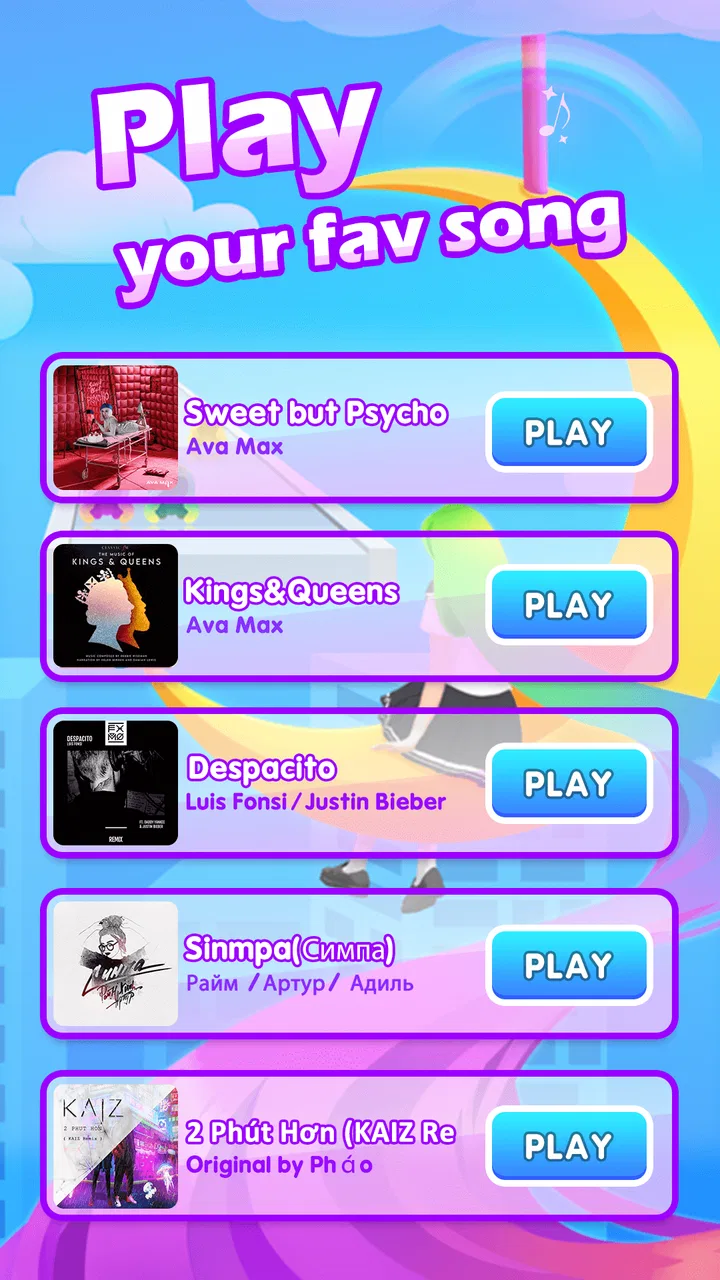
The first thing I noticed about Dancing Hair: Dress Up is how quickly it communicates its idea. This is a free music game from TINYMAX HONGKONG LIMITED built around movement, appearance, and a playful catwalk mood. Instead of presenting itself as a serious rhythm trainer, it aims for a lighter experience: guide a character through musical stages, keep the motion flowing, and enjoy the visual payoff of long hair and changing outfits.
That simple pitch is also the reason it is easy to understand within a few moments. I did not need a long explanation to grasp what the game wanted from me. The attraction is immediate for players who like colorful presentation, short sessions, and the satisfaction of matching actions to a song while watching a character become more stylish. It feels designed for casual play rather than for people searching for a deep music-game system.
The game is listed for Everyone, which fits its cheerful presentation and uncomplicated premise. It is free to install, although optional in-app purchases range from around two dollars to around forty dollars per item. That makes it important to approach the game as a free tryout first rather than assuming every cosmetic or progression option will be available without spending.
You May Also Like

 Pandora - Music & Podcasts
Pandora’s Music Is Easy to Start, but Harder to Recover
Pandora’s strength is its low-effort path from a seed to a station. Its weak spot is how much confidence it asks you to place in connection, setup, and quiet recovery.

 8 Ball Pool
 Is Built on Rivalries, Rematches, and Routine
A close look at the rivalries, rematches, shared routines, and unanswered safety questions that turn a quick pool match into a persistent mobile community.

 Samsung Music
’s Quiet Strength Is Playing What You Already Own
Its reach comes less from spectacle than from dependable access to a personal library. That simplicity is both the app’s strongest retention engine and its ceiling.

 AccuWeather: Weather Radar
AccuWeather Review: A Quick, Clear Forecast for Everyday Decisions
For everyday plans, the best forecast is the one you can understand quickly. AccuWeather makes rain timing, radar, and local conditions easy to act on, with a few trade-offs.

 Hill Climb Racing
Why Hill Climb Racing Still Turns Crashes Into One More Run
A tiny car, a bumpy hill and one more upgrade: Hill Climb Racing keeps resurfacing because its simple chaos makes every near-miss feel personal.

 AliExpress - Shopping App
AliExpress Makes Global Shopping Feel Personal, but Shoppers Bear the Risk
AliExpress turns a global marketplace into a pocket-sized discovery engine. Its reach is useful, its shopping loop compelling, and its trade-offs easy to miss.
More From Our News Desk
View All News


A bright first impression built around movement
My first impression was that the game treats the character’s hair as part of the performance, not just as a decoration. The long-hair theme gives each run a visible sense of motion. When the character moves through a stage, the hair helps sell the feeling that the avatar is dancing even when the underlying interaction remains simple. That visual connection is clever because it makes a basic action feel more expressive.
The presentation is deliberately friendly. Nothing about the concept demands a complicated backstory or a large cast of characters. The focus stays on the performer, the route ahead, the music, and the look created by the run. I found that useful when I wanted something I could open for a short break without first remembering a complicated control scheme or a long chain of objectives.
At the same time, the light approach means the game may not satisfy players who expect a traditional rhythm title with demanding note charts, detailed scoring, or a large collection of strategic systems. Its appeal is closer to a musical dress-up experience with game-like timing than to a specialist rhythm simulator. That distinction matters. If you want precision practice, another music game will probably offer more depth. If you want a colorful performance loop, this one makes a stronger case.
The game has reached over fifty million installs and carries an average rating of 4.3 from roughly fifty-one thousand ratings. Those figures suggest that its accessible formula has found a broad audience, but popularity should not be confused with complexity. I would recommend it because the concept is approachable, not because it tries to compete with the most demanding games in the music category.
Why the visual idea works
The most effective design choice is the way appearance and action are connected. In many dress-up games, clothing is something selected before the real activity begins. Here, the look belongs to the movement itself. The hair becomes a visual trail of progress, while the catwalk framing gives the player a reason to care about what the character looks like at the end of a stage.
I also think this makes the game easier to share informally with younger players or friends who are not regular gamers. Someone can understand the goal by watching the screen for a few seconds. There is no need to explain a complex role, a team composition, or a long-term build. The visual language does most of the teaching.
There is a trade-off, though. A game built around a strong visual hook can feel repetitive if the stages do not keep offering enough variation. I found myself judging each session by two questions: did the route give me something different to react to, and did the final look feel worth the effort? When the answer was yes, the short format worked well. When the answer was no, the experience felt more like repeating a familiar animation than playing a new song.
The world speaks through fashion, color, and motion
This is not a world-building game in the usual sense. Its setting is more like a moving fashion stage, where the environment exists to frame the performer. That narrow focus is a strength because it keeps the mood coherent. The game does not need to interrupt a run with heavy exposition. It can communicate through silhouettes, color choices, hair movement, and the rhythm of the route.
I enjoyed that economy. The character’s appearance is not separate from the setting; it is the main way the player reads the setting. A catwalk atmosphere naturally encourages attention to presentation, and the game’s central idea remains understandable whether I played for a few minutes or returned after a longer break.
For players who enjoy customizing avatars, the visual reward is likely to be more important than the score itself. I found that the anticipation of seeing the finished style can change how I approach a stage. Rather than treating every obstacle as an isolated tap or swipe, I start thinking about the run as a performance with a target look. That small mental shift gives the otherwise simple action a little more personality.
One useful habit is to pay attention to the whole route instead of staring only at the character. The game’s visual cues are easier to read when I keep the upcoming path in view. Looking too closely at the hair or outfit can make me react late, while watching the route first lets the appearance become the reward rather than the distraction. This is a small adjustment, but it makes the game feel smoother.
Where the art direction has limits
The same focused presentation can feel narrow for players who want a substantial fictional world. There is no reason to approach this as an adventure with layered lore or a story-driven campaign. Its setting is a mood and a stage, not a place I explore for narrative discovery. I think that is perfectly acceptable for a casual music game, but it is worth knowing before downloading.
The visual style also places pressure on pacing. If a stage begins and ends too quickly without a satisfying change in appearance or rhythm, the catwalk idea loses some of its impact. The best moments are those in which the route, the music, and the character’s movement seem to point in the same direction. The weaker moments are not necessarily difficult; they simply feel like a sequence of actions without enough visual consequence.
For that reason, I would not choose this game as my only dress-up experience. A dedicated fashion title is better when I want detailed control over clothing combinations, while a conventional rhythm game is better when I want to study timing and chase high scores. Dancing Hair: Dress Up sits between those choices, using fashion as motivation for a compact musical interaction.
Sound gives the stages their forward pull
The music is essential because it turns the route into more than a visual obstacle course. Even when the interaction is straightforward, a beat gives the player a sense of forward motion. I found myself using the song as a pacing guide, especially when the screen was busy. The sound helps the stage feel like a performance rather than a sequence of unrelated movements.
What I like about this approach is that the music does not need to be treated as a technical test for it to be useful. I can play by watching the route, but listening makes the experience more natural. This is particularly helpful during a quick session when I do not want to concentrate on every visual detail. The beat provides a second layer of orientation.
There is also a practical reason to try both sound-on and sound-off play. With audio, the game feels more coherent and energetic. Without it, the experience becomes more dependent on visual timing and may feel flatter, though it remains suitable for situations such as a quiet waiting room. I would use headphones when I wanted the strongest musical atmosphere, but I would not describe the game as something that requires a dedicated listening setup.
The sound and art direction work best together when the stage gives the music room to breathe. If the route becomes visually crowded, I pay less attention to the song and more attention to avoiding mistakes. That is an important trade-off: the game wants to create a relaxed performance mood, but the player still has to read what is happening. Clear visual priorities matter as much as the soundtrack.
How to use the rhythm without overthinking it
My most useful approach is to listen for the general pulse rather than trying to predict every action from the song. I watch the route first, then let the music help me maintain a steady tempo. This prevents a common mistake: tapping too early because the sound feels exciting, or reacting too late because I am watching the character’s hair instead of the next section of the path.
Another practical tip is to treat the opening of a stage as a calibration moment. I use the first few movements to understand how quickly the game expects me to react and whether the visual timing feels comfortable on my device. Once I settle into that pace, the music becomes a support rather than a source of pressure.
Players who need exact musical notation, complex patterns, or a demanding score chase should keep their expectations modest. The rhythm is there to shape the mood and guide the action, not necessarily to turn every stage into an expert-level performance exam. That makes the game more welcoming, but it also limits its appeal for serious rhythm-game fans.
Simple mechanics that fit the mood
The mechanics are at their best when they stay out of the way. The player’s attention belongs to the route, the timing, and the evolving appearance. I appreciate that the game does not make me manage a large inventory or learn a complicated control vocabulary before I can enjoy a stage. The directness suits the music-and-catwalk concept.
That simplicity is especially useful in everyday situations. I can imagine playing during a short commute, while waiting for an appointment, or during a break when I want a complete activity rather than an endless feed. A quick session has a recognizable beginning and payoff: enter the stage, follow the movement, and see how the performance develops. This makes it easier to stop than a game built around long competitive matches.
However, short-session design can create a limitation for players who want a strong sense of long-term mastery. Once I understand the basic relationship between movement, music, and appearance, the challenge depends heavily on how much variety the stages provide. If I am looking for a game that rewards advanced planning over many hours, I would choose something with deeper progression or more demanding rhythm patterns.
The best way to enjoy this game is to judge success by more than perfect execution. I pay attention to whether I stayed in the flow and whether the final presentation felt satisfying. That mindset matches the game’s personality. Trying to force it into the role of a competitive rhythm title makes its limitations more obvious, while treating it as a stylish musical arcade experience makes the design feel more intentional.
Who should play and who should skip it
I would recommend it to players who enjoy colorful mobile games, light customization, and music-backed actions without a steep learning curve. It is also a reasonable choice for families looking for an Everyone-rated game with an immediately understandable premise. The visual focus may appeal to someone who normally ignores rhythm games but enjoys fashion or character styling.
I would be more cautious about recommending it to players who dislike repeated short stages, prefer realistic art direction, or want complete control over every clothing detail. I would also point serious rhythm enthusiasts toward a more technical alternative. A dedicated rhythm game will usually be the better choice for chart precision, competitive scoring, and long-term mechanical improvement.
The in-app purchase range is another reason to decide your spending boundary early. I would begin with the free experience, see whether the core loop remains enjoyable after several sessions, and only then consider optional purchases. Spending makes sense only if the visual rewards genuinely improve your enjoyment; it should not be treated as a requirement for understanding the game.
The current version is 1.0.99, and the game supports Android 7.0 or later. That makes it accessible to people using older compatible Android devices, though the actual comfort of play will still depend on screen responsiveness and performance. For a timing-focused game, even small delays can affect the experience, so I would close demanding background apps if the controls feel inconsistent.
A coherent mood with a deliberately light finish
What stays with me is the consistency between the game’s art direction, sound, setting, and pacing. The long-hair concept is not merely a sentence in the description; it shapes how the character moves and how the player reads the reward. The catwalk framing gives the stages a recognizable identity, while the music supplies the forward pull needed to make simple actions feel like a performance.
That coherence does not erase the game’s limitations. The world is not built for deep exploration, the mechanics are not aimed at expert rhythm players, and the free-to-play structure means I would pay attention to optional spending rather than assume every style element is equally available. Repetition may also become noticeable for players who need constant mechanical novelty.
Still, I think the focused design is more of a strength than a weakness. The game knows that its pleasure comes from the combination of movement and appearance. It does not need to become a complicated simulation to deliver that feeling. When I want a colorful, low-pressure music game that can fit into a short break, it gives me a clear reason to return.
My final recommendation is therefore specific: try it if you want a playful musical catwalk and enjoy watching an avatar’s look develop through action. Do not choose it as a replacement for a serious rhythm trainer or a deep fashion editor. Its strongest quality is the way rhythm, hair movement, and presentation reinforce one another, creating a compact mood that is easy to enter and easy to understand.
For me, that makes Dancing Hair: Dress Up a pleasant casual game rather than an all-purpose music experience. Its average rating of 4.3 and audience of more than fifty million installs show how approachable the formula has become, but the real decision comes down to taste. If the idea of turning a short rhythm session into a miniature runway performance sounds fun, this free game is worth trying. If you need demanding timing systems, extensive storytelling, or detailed wardrobe control, another category specialist will serve you better.
FAQs for Dancing Hair: Dress Up
01What is Dancing Hair: Dress Up about?
Dancing Hair: Dress Up is a vibrant and engaging mobile game that combines elements of rhythm and fashion. Players guide their character through various dance challenges while customizing their hairstyle and outfit. The game offers a unique blend of music and style, making it a must-try for fans of both genres.
02Is Dancing Hair: Dress Up free to play?
Yes, Dancing Hair: Dress Up is free to download and play. However, it includes in-app purchases that allow players to buy additional hairstyles, outfits, and other customization options. These purchases can enhance the gaming experience but are not essential for progressing in the game.
03What are the main features of Dancing Hair: Dress Up?
The game features a wide variety of dance challenges, customizable characters with unique hairstyles and outfits, and an engaging rhythm-based gameplay. It also offers regular updates with new content, leaderboards to compete with friends, and a vibrant soundtrack that enhances the overall experience.
04Can I play Dancing Hair: Dress Up offline?
Dancing Hair: Dress Up requires an internet connection for the best experience, especially to access new content and updates. However, some basic features and levels may be available offline, allowing players to enjoy the game even without connectivity at all times.
05Is Dancing Hair: Dress Up suitable for children?
Dancing Hair: Dress Up is suitable for a wide audience, including children. The game is designed with colorful graphics and simple controls, making it accessible for younger players. However, parents should be aware of in-app purchases and may want to manage settings accordingly to prevent unintended spending.
Pros
- Engaging and colorful graphics.
- Intuitive touch controls.
- Wide variety of hairstyles.
- Regular updates with new content.
- Fun soundtrack enhances gameplay.
Cons
- In-app purchases can be costly.
- Requires internet for full features.
- Occasional ads interrupt gameplay.
- Limited customization options.
- Some levels feel repetitive.

Dancing Hair: Dress Up
Gallery